Camping is a genuinely new system in WoW Forever: you place a campfire in the world, other players contribute crafted objects to it, and anyone who rests at the fire picks up the buffs those objects provide.
Every guide will hand you the object list. Here's the rule that determines whether any of it is worth your time, and it's buried in most coverage:
Camp buffs do not stack with class buffs.
Mana Well doesn't stack with Blessing of Wisdom. Incense Candle doesn't stack with Arcane Intellect. Fish Bowl doesn't stack with Blessing of Kings. Nine of the eleven buff objects are blocked by a class buff that someone in your group may already be providing.
Which means a fully built camp is worth almost nothing to a group with a Paladin, Priest, Druid, Mage and Shaman in it — and worth a great deal to a solo player or a group missing buff classes.
And exactly one object has no class equivalent at all. We'll get to which one, because it's the most valuable thing in the system.
Quick Reference
| |
|---|
Unlocks at | Level 5, via The Great Outdoors |
Gatekeeper profession | Cooking — campfire tiers are Cooking-gated |
First objects at | 20 profession skill |
Objects per player | One per camp |
Campfire slots | 3 / 5 / 10 depending on tier |
Buff duration | 1 hour, after ~1 minute resting |
Object cooldown | 1 hour per player, shared across all camps |
Placement | Outdoors only, no cities, camps 100+ yards apart |
Unlocking Camping
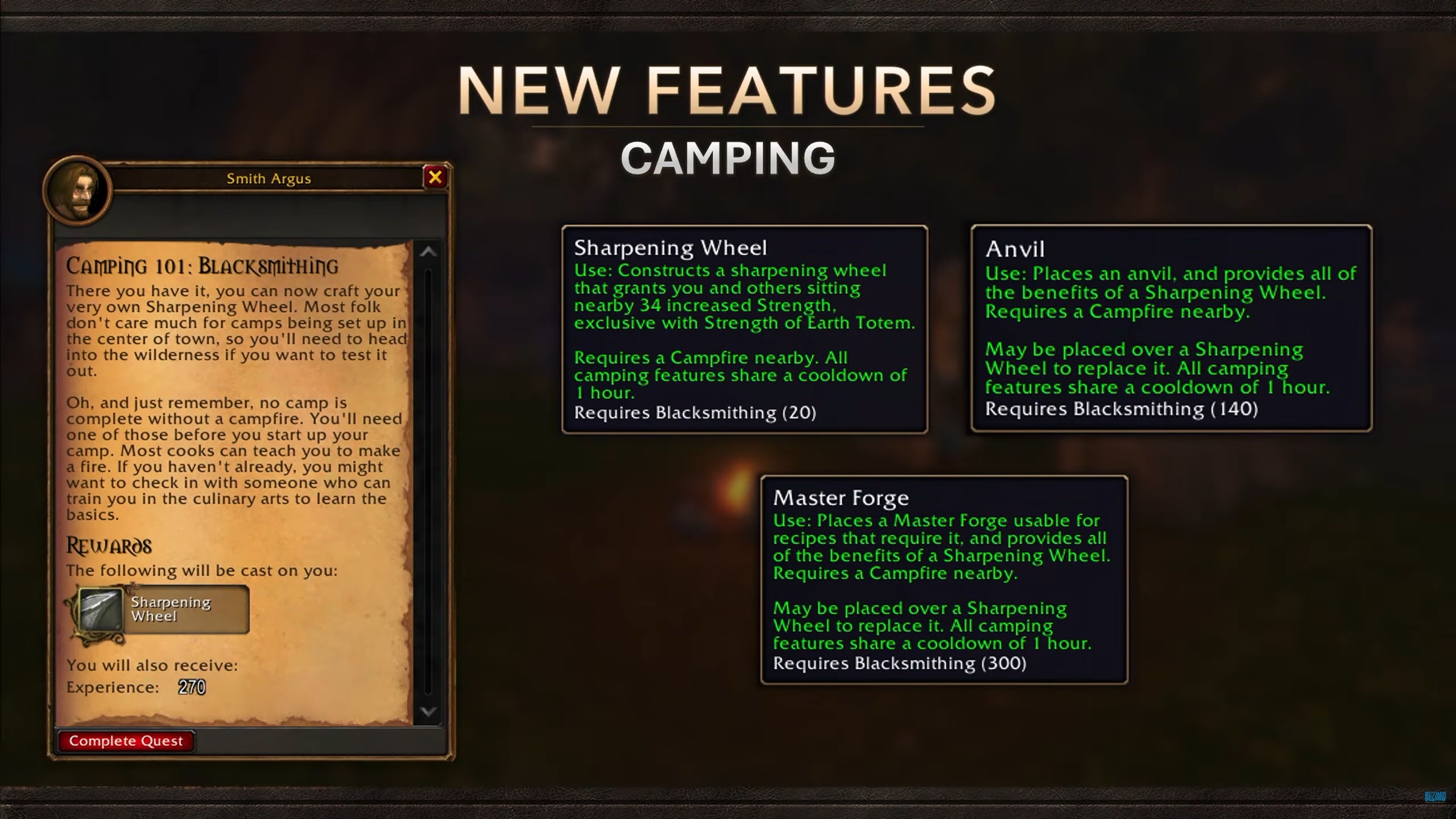
1. Level 5 — The Great Outdoors. An NPC near your starting area gives it. Sitting at the fire in front of the quest giver completes it.
2. The follow-up sends you to the Cooking trainer in the nearest town. The Basic Campfire Kit requires just Cooking skill 1, plus one Simple Wood and Flint and Tinder — both sold by the Cooking Trainer.
3. Camping 101 quests appear for each profession you've trained. Turn one in at that profession's trainer and it teaches you that profession's Tier 1 camp object.
So the full unlock is: one quest at level 5, Cooking from any town trainer, then one short quest per profession you have.
Tier 1 objects require 20 profession skill — which is nearly immediate on a new profession. Camping is a levelling system, not an endgame one.
Campfire Tiers — Cooking Decides Your Capacity
The campfire itself is gated by Cooking skill, not by the professions that make the objects.
Campfire | Cooking Skill | Reagent | Object Slots |
|---|
Basic Campfire Kit | 1 | Simple Wood | 3 |
Journeyman Campfire Kit | 90 | Star Wood | 5 |
Expert Campfire Kit | 200 | Thick Logs | 10 |
Cooking also has two objects of its own:
Cookie's Feast (Cooking 140) — Stamina food for the whole camp. Requires a Cooking Fire nearby.
Iron Oven (Cooking 300) — required for the most advanced Cooking recipes. Reagents: Simple Flour ×10, Refreshing Spring Water ×5, Soothing Spices ×4.
The honest trade on Cooking: it's the gatekeeper for the whole Camping system, and it awards zero Legacy Points — Legacy only counts the six non-gathering primary professions. Levelling Cooking to 200 for a 10-slot campfire is a real investment with no account progression attached. Worth it if you intend to host camps; skippable if you only intend to use other people's. See our Legacy Points guide for the full challenge list.
The Exclusivity Table — What Each Object Actually Replaces
This is the table that should come first in every Camping guide and doesn't.
Camp buffs are substitutes for class buffs, not additions to them. So the right way to read the object list is: which missing class does this object cover?
Missing From Your Group | Object That Covers It | Profession | Effect |
|---|
Paladin — Blessing of Kings | Fish Bowl | Fishing | 8% increased stats |
Paladin — Blessing of Might | Lodestone | Mining | Melee Attack Power |
Paladin — Blessing of Wisdom | Mana Well | Alchemy | Mana regeneration |
Priest — Power Word: Fortitude | First Aid Kit | First Aid | Stamina |
Priest — Divine Spirit | Faction Banner | Tailoring | Spirit |
Druid — Mark of the Wild | Enchanted Lute | Enchanting | Armor, all stats, all resistances |
Balance Druid — Moonkin Aura | Camp Chair | Skinning | 2% critical strike |
Mage — Arcane Intellect | Incense Candle | Herbalism | Intellect |
Shaman — Strength of Earth Totem | Sharpening Wheel | Blacksmithing | Strength |
Nothing — always useful | Camp Tent | Leatherworking | Rested experience, up to 5% of a level |
Three immediate conclusions:
1. Fish Bowl is the best single buff in the system. 8% to all stats is the largest raw effect on the list, and it's the Paladin substitute. If your group has no Paladin, this is the object you want in the camp. It comes from Fishing — a secondary profession, which is a surprising place for the strongest buff to live.
2. A camp's value is inverse to your group's buff coverage. A five-man with a Paladin, Priest, Druid, Mage and Shaman is already covered on nine of the ten rows. For that group, a fully built camp adds one thing. For a group of four Warriors and a Rogue, it adds nearly everything.
3. Camp Tent is the most valuable object in the game. Read the bottom row again — it is the only object with no class equivalent. Every other buff can be made redundant by the right group composition. The Tent never can.
Why Camp Tent Wins
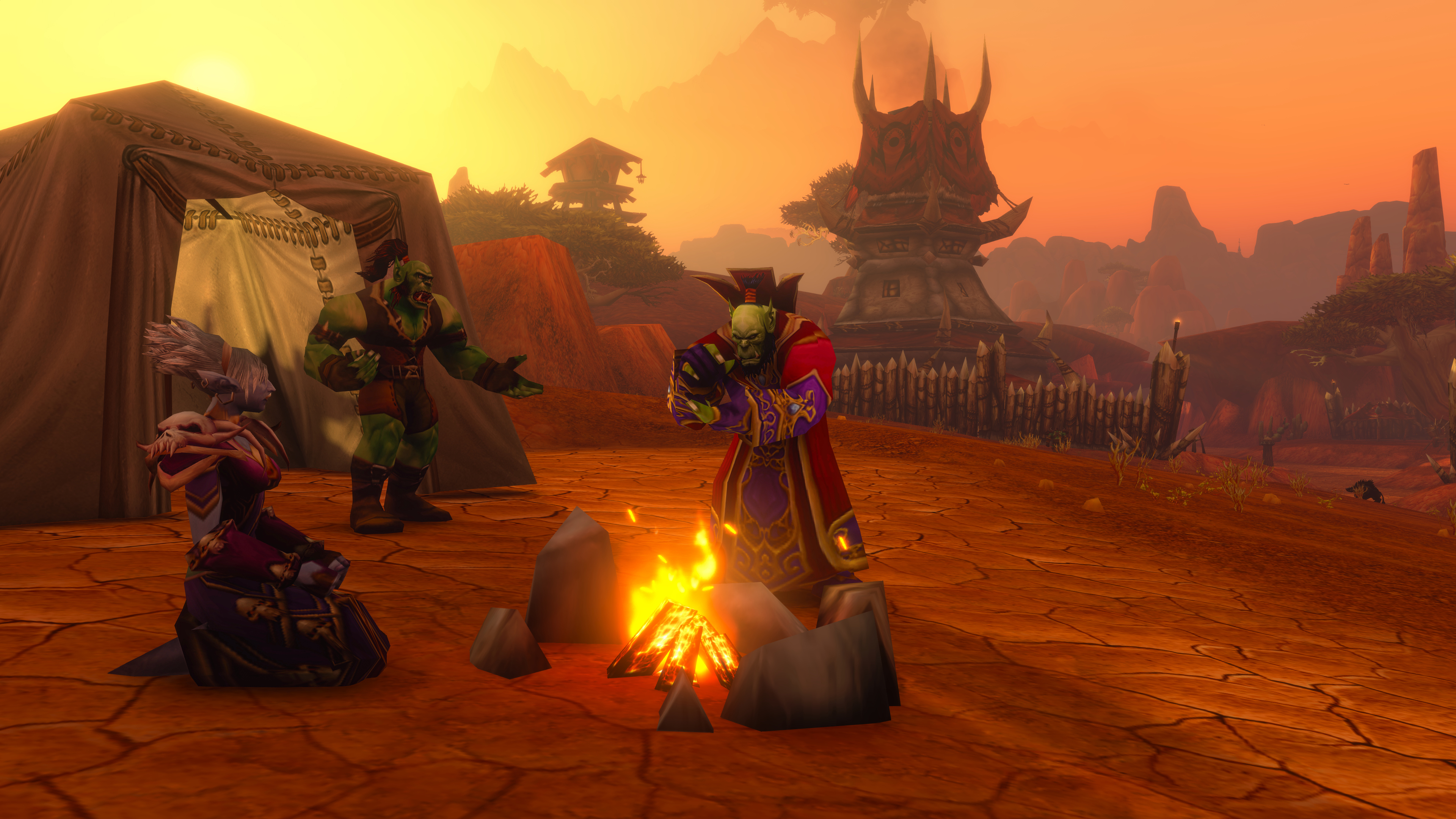
Camp Tent (Leatherworking, skill 20) grants rested experience, up to 5% of a level.
Four reasons it outranks everything else:
No class provides rested experience. It cannot be made redundant by group composition, unlike all nine buff objects above.
It's levelling value, and Forever is a levelling game. 1–60 takes most players 100–180 hours. 5% of a level, repeatedly, across that climb compounds in a way a stat buff doesn't.
It works for everyone at the camp regardless of class, spec or role. No stat preference, no dead rows.
It's cheap — Light Leather ×5 at skill 20.
If you're choosing one profession to support Camping with, Leatherworking is the answer. And if you're a solo player who can only ever place one object, the Tent is the one that always does something.
Every Object, All Three Tiers
Each profession has three tiers, learned at skill 20, 140 and 300. Tier 2 and 3 objects keep the tier 1 buff and add a service on top — so a higher tier is strictly better and occupies the same slot. A stronger object can replace a weaker one in a slot.
The Services Tier 2 and 3 Add
Alchemy — Fermenter sells reagents; Laboratory enables lab-only recipes
Blacksmithing — Anvil provides anvil crafting; Master Forge enables forge recipes
Enchanting — Arcane Salvager lets you disenchant at the camp; Arcane Forge enables forge recipes
Engineering — Reagent Bot sells reagents; Repair Bot repairs your gear; Anarchist's Workbench enables workbench recipes
Herbalism — Greenhouse grows herbs; Seed Hybridizer combines seeds
Leatherworking — Tanning Rack sells reagents; Sewing Machine enables recipes
Mining — Rock Garden provides a mining node; Molten Foundry enables recipes
Skinning — Field Guide grants Track Beasts; Trapper's Workbench provides a trap
Tailoring — Spinning Wheel sells reagents; Loom enables recipes
Fishing — Fishing Rack yields uncommon fish; Fishing Hut yields rare fish
Engineering is the pure-utility profession here. It's the only one with no buff at all — but Repair Bot in the field is genuinely valuable on a long levelling session, and it's the thing a camp can offer that nothing else does. If you're the Engineer in a group, your contribution is services, not stats.
Tier 1 Reagents — All at Skill 20
Cheap enough to make Camping accessible almost immediately.
Object | Reagents |
|---|
Camp Tent | Light Leather ×5 |
Camp Chair | Light Leather ×3, Simple Wood ×2 |
Mana Well | Peacebloom, Empty Vial |
Incense Candle | Peacebloom, Silverleaf |
Sharpening Wheel | Rough Stone, Copper Bar |
Lodestone | Rough Stone, Copper Bar |
Enchanted Lute | Simple Wood, Strange Dust |
Reagent Bot | Handful of Copper Bolts, Copper Tube |
Faction Banner | Bolt of Linen Cloth, Coarse Thread |
Each craft yields two objects, and each object is consumed on placement.
The Rules That Shape How Camping Works
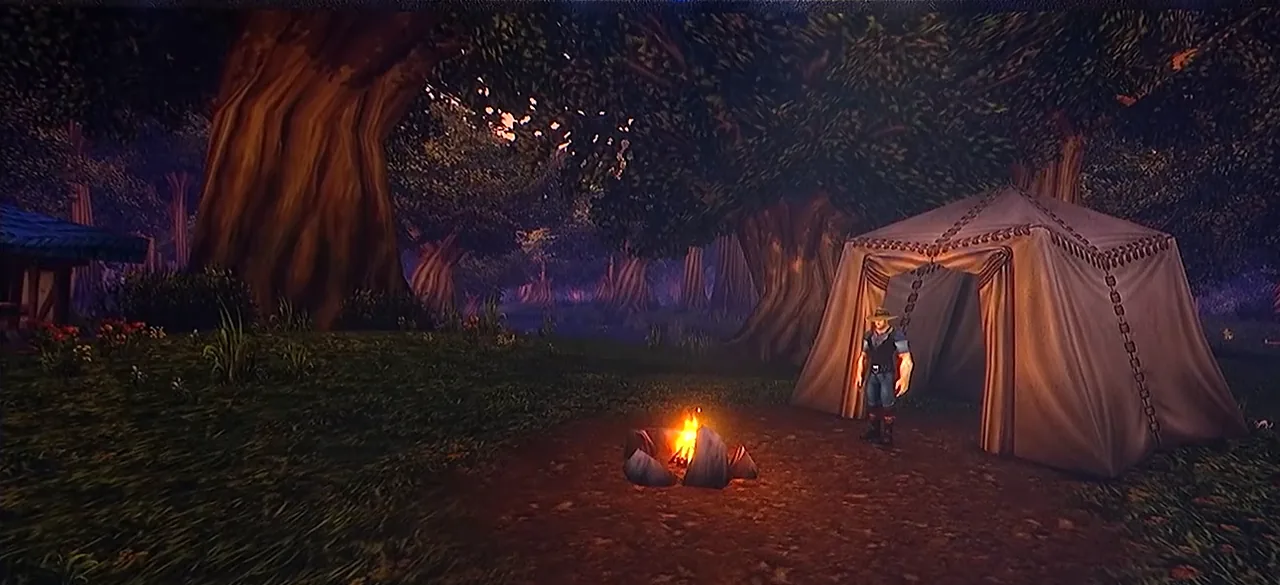
One Object Per Player
Each player can contribute one object to a camp. That's the social mechanic, and it has a direct consequence most people miss:
A Basic Campfire has 3 slots, so filling it needs three players. An Expert Campfire has 10 slots, so filling it needs ten.
You cannot build a complete camp alone. A solo player places one object and that's it — which is why choosing Leatherworking for the Tent matters so much if you play alone.
Cooldowns
Objects: 1 hour per player, shared across all camps. You cannot hop between camps placing objects. One contribution per hour, wherever you make it.
Campfire: about 5 minutes.
Buffs: 1 hour, gained after resting near the fire for about one minute.
How to Gain the Buffs
Rest near the fire for roughly a minute. Sitting, lying down, sleeping and the kneel emote all count. Crafting and casting don't interrupt the timer — so you can work at the camp while it ticks.
No profession skill and no group are required to use the buffs. Anyone can walk up to a camp and take what's there. Placing an object does require the matching profession skill, even if you bought the object rather than crafted it.
Placement
Outdoors only. No cities.
Camps must be at least 100 yards apart.
Camps provide no protection. Keep off roads and away from patrol routes — and on a PvP ruleset, treat a campfire as a flare announcing your position to anyone nearby.
Lifetime
Early beta estimates put a campfire and its objects at roughly 10 to 15 minutes before they disappear. That figure comes from one source and may change.
The important implication: the camp is temporary, the buff is not. You don't sit at a camp for an hour — you spend a minute there and leave with an hour of buffs. A camp you build serves passers-by for about a quarter of an hour.
Fire Damage
Since the October 1 build, campfires no longer damage characters below level 5, and deal reduced damage to anyone under 90% health. If you remember fires killing low-level characters in earlier beta builds, that's been addressed.
Blueprints — Tier 2 Comes From Dungeons
A detail that changes how you progress: many Tier 2 objects are Blueprints dropped by dungeon bosses, not recipes taught by trainers.
The one confirmed example: the Greenhouse blueprint drops from Shadetooth in Excavation Site: Wetlands.
The complete blueprint list, drop locations and material costs haven't been confirmed yet. If you're missing a Tier 2 object and your trainer doesn't offer it, a dungeon drop is the likely reason. We'll fill this section in as the list is documented.
Legacy Perks That Support Camping
Three Legacy talents interact with Camping directly, from the pre-release build — values may change:
Perk | Ranks | Effect |
|---|
Field Guide | 3 | Reduces the object cooldown by 8% per rank — up to 24% |
Permanence | 2 | Camp buffs last 50% longer |
Reagent Economy | 1 | Intended to make Tier 1 objects free to craft |
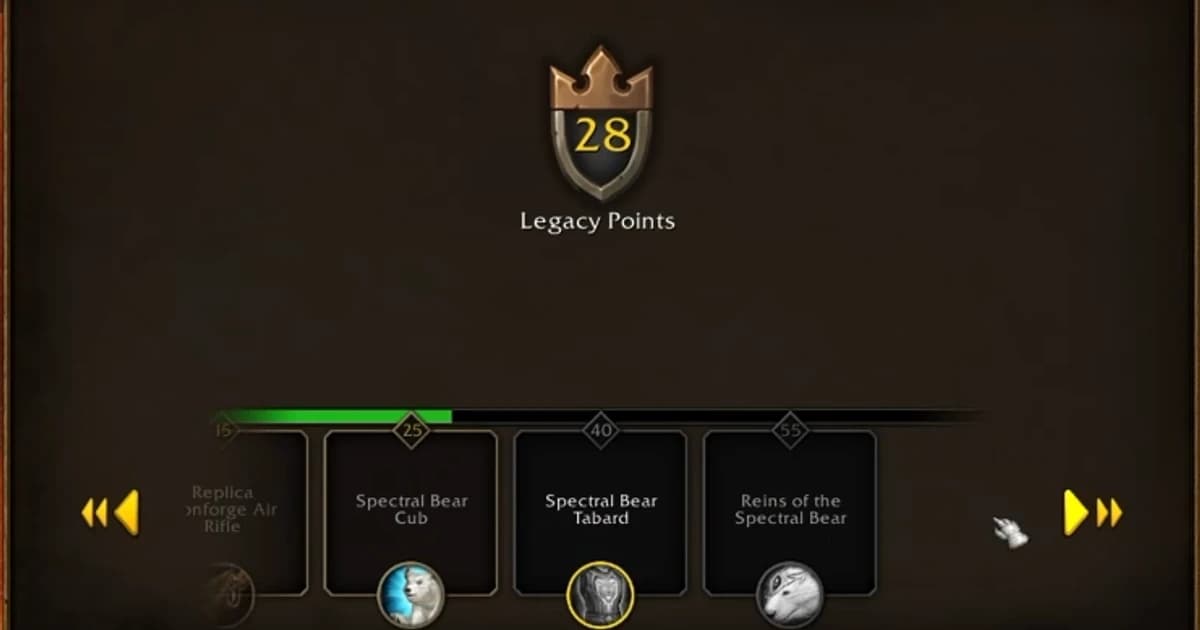
Permanence is the standout, and it's doing double duty — it also extends eligible long-duration class buffs on your party or raid by 50%, which is why it's already a strong raid pick. If you camp regularly as well, it's the clearest value in the tree. Our Legacy System guide covers the full perk trees and build priorities.
One flagged discrepancy: as of the October 15 build, the Reagent Economy tooltip only mentions class reagents, not camp objects, despite the intended effect. Either the tooltip is incomplete or the perk's scope changed. Verify in-game before spending a point on it for Camping specifically.
Who Should Actually Invest in Camping
Worth real investment if you:
Level mostly solo or in small groups missing buff classes
Play Leatherworking (Camp Tent) or Fishing (Fish Bowl — the strongest buff)
Intend to host camps, which means Cooking to 90 or 200 for the bigger fires
Want the Repair Bot as an Engineer, which no other system provides in the field
Lower priority if you:
Run in a full group with a Paladin, Priest, Druid, Mage and Shaman — nine of the ten buffs are already covered
Only ever use other people's camps, in which case you need nothing at all. Buffs require no skill and no group.
The free option nobody mentions: using a camp costs you nothing — no profession, no reagents, no group. If you see a fire while you're questing, stop for a minute. An hour of buffs for sixty seconds of sitting is the best rate of return in the game, and you don't have to build anything.
For how Camping fits into profession planning overall, see our best professions guide and the Forever overview.
FAQ
How do I unlock Camping? At level 5, complete The Great Outdoors from an NPC near your starting area — you sit at the fire in front of them. The follow-up sends you to a Cooking trainer, where the Basic Campfire Kit needs only Cooking skill 1. Each profession you've trained then has a "Camping 101" quest that teaches its first camp object.
Do camp buffs stack with class buffs? No. Nine of the eleven buff objects are blocked by a specific class buff — Mana Well with Blessing of Wisdom, Incense Candle with Arcane Intellect, Fish Bowl with Blessing of Kings, and so on. Camp Tent is the only object with no class equivalent, and Engineering's objects provide services rather than buffs.
What's the best camp object? Camp Tent (Leatherworking) for overall value — it's the only one that can't be made redundant by your group, and rested experience is worth the most across a long levelling climb. Fish Bowl (Fishing) for the strongest single buff at 8% increased stats, if your group has no Paladin.
How many objects can I place? One per camp, on a one-hour cooldown shared across all camps. A Basic Campfire's three slots therefore need three different players to fill.
How long do the buffs last? One hour, gained after resting near the fire for about a minute. Sitting, lying down, sleeping and the kneel emote all count, and crafting or casting won't interrupt the timer.
Do I need a profession to use a camp? No. Using the buffs requires no skill and no group — anyone can walk up and benefit. You only need the matching profession skill to place an object, even one you bought rather than crafted.
Where can I place a campfire? Outdoors, anywhere except cities, and at least 100 yards from another camp. Avoid roads and patrol routes; camps offer no protection, and on a PvP ruleset a fire advertises your location.
How big can a campfire get? Three slots at Cooking 1, five at Cooking 90, ten at Cooking 200. The campfire tier is gated by Cooking skill, not by the professions making the objects.
Where do Tier 2 objects come from? Many are Blueprints dropped by dungeon bosses rather than trainer recipes. The Greenhouse blueprint, for instance, drops from Shadetooth in Excavation Site: Wetlands. The full list isn't documented yet.
Is Cooking worth levelling for Camping? Only if you plan to host. Cooking gates campfire capacity, but it awards no Legacy Points since Legacy only counts the six non-gathering primary professions. If you mostly use other players' camps, you don't need it past 1.
The Short Version
Unlock it at level 5 with The Great Outdoors, then Cooking 1 for the Basic Campfire. Tier 1 objects need just 20 profession skill.
The rule that matters: camp buffs don't stack with class buffs. Work out what your group is missing and bring the object that covers it — Fish Bowl for a missing Paladin, First Aid Kit for a missing Priest, Enchanted Lute for a missing Druid.
Camp Tent is the best object in the system because it's the only one with no class equivalent, and rested experience up to 5% of a level pays across a 100-plus-hour climb. Leatherworking is the profession to have.
You can place one object per hour, so a three-slot fire needs three players. And using a camp is free — no profession, no group, sixty seconds of sitting for an hour of buffs. Stop at every fire you pass.


 WoW Forever